
 When assessing for safety and risk factors, focus should keep in mind elements of a youth and family’s life (people, environments, danger) that contribute to the development of negative behaviors (violence; delinquency).
A safety risk involves the potential for harm to self, others, property, and/or community
Crisis Escalation Curve
Below comes from an IHBT workshop presentation by Bobbi Beale, PsyD in relation to youth/client, family, and clinician safety.
DOWNLOAD Crisis Escalation Curve PDF (Pictured below right.)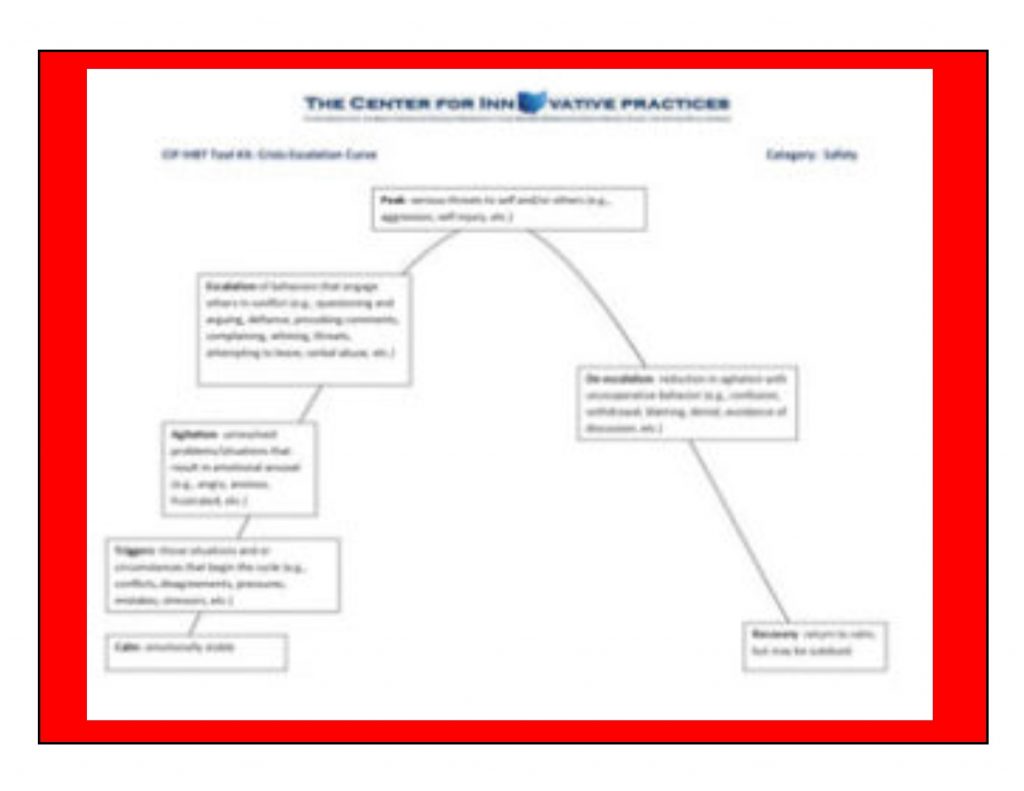
Stabilize, Reduce Risks, and Plan for Safety
– Symptom stabilization: Prevent a chain reaction of negative life events (Mark Katz)
– Address basic needs
– Build resources and supports where they are needed
– Develop safety net of supports
– Establish basic safety
– Create trauma-free recovery environments
– Crisis stabilization
– Safety planning
– Reduce risk factors
– Decrease risk generating environments and people (e.g. negative peers)
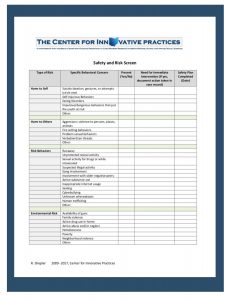 Safety and Risk Screen
(Click here or on image at right to download Safety and Risk Screen PDF.)
Protective Measures in the Home: Safety Walk Through
• Safety tour of the house
• Completed with parent or caretaking adult (and not the youth)
• Walk through each room of the house prompting the parent/adult with safety questions:
–Tell me what is in this room that could pose a danger to someone?
–Think about your son or daughter and what they may have done before–what is in this room that we need to secure?
•Have parents secure items of concern and confirm actions were taken
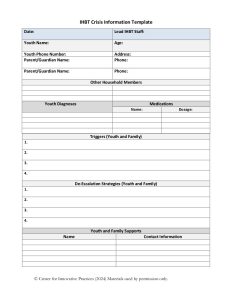
Safety Planning Framework and Safety and Crisis Management Plan
(Click here to download IHBT Safety Planning Framework PDF and click here to download IHBT Safety and Crisis Management Plan PDF, both pictured below.)
 Developing a Plan for Crisis Response and Stabilization
When assembling and developing a Plan for 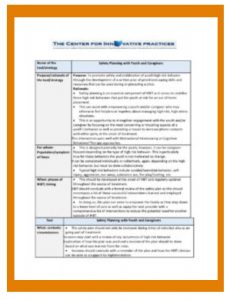 Crisis Response and Stabilization, the following facets should be kept in mind and ensured:
– Implement safety plan (Requires 24/7 availability)
– Decide on level of intervention and type of response
– Direct action: de-escalation/stabilization
– Model calm, non-threatening, yet directive approach
– Do not add to the family’s reactivity
– Verbal responses should be short and simple
– Create safe environment:
– Secure unsafe items
– Commitment to safety
– Therapeutic separation
– Mobilize supports
– Respite: Arrange for short term out of home stay
– Hospitalization or psychiatric assessment
– Stepped up intensity & monitoring (by family; IHBT staff)

IHBTOhio.org is presented by The Center for Innovative Practices (CIP)
and the Child and Adolescent Behavioral Health Center of Excellence (CABH COE)
Part of the Begun Center for Violence Prevention
at Case Western Reserve University’s Mandel School of Applied Social Services
Mailing Address: 10900 Euclid Avenue | Cleveland, OH 44106-7164
© 2022 Center for Innovative Practices, Cleveland, Ohio 44106

 Consistent with the Ohio Department of Medicaid’s (ODM) and OhioMHAS, rules to promote high-quality service, the IHBT Fidelity Tool was developed to ensure compliance with IHBT service delivery standards. Providers choosing to bill services under Medicaid’s IHBT bundled rate must be certified. Certification assures minimum fidelity standards are being met.